

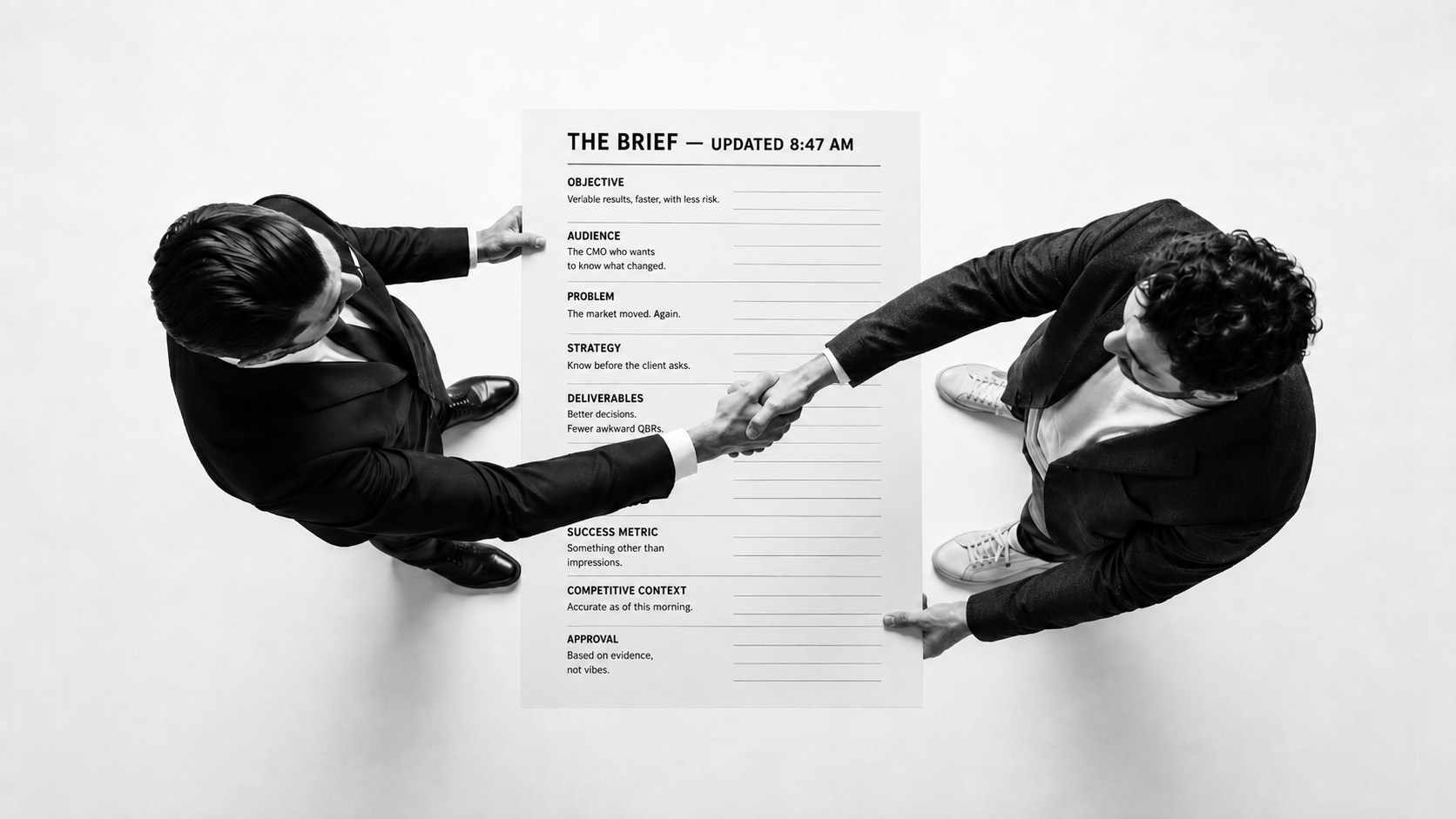
Why Brand Performance Management is becoming a core service line for advertising, brand, and marketing agencies.
The agency-client relationship used to be simpler. You brought the creative vision and the ability to execute it. The client brought the budget and the brief. And the work got measured. Reach, recall, response rates, and eventually clicks and conversions. Campaign measurement has been part of this business for as long as there's been a business.
What was never really measurable was the brand itself. A campaign could hit every number on the media plan and still pull the brand somewhere it shouldn't go — and nobody would know for quarters, sometimes years. Brand moved slowly, through feel and cumulative impression. There was no live score for it. Which also meant there was no way to know whether the brief was right in the first place.
That's changing fast.
Clients now have more brand intelligence than ever: sentiment data, competitive tracking tools, AI-generated summaries of how their brand is perceived. They know more about their market. They expect you to know more. And when a strategy underperforms or a campaign misses, the conversation is no longer about creative subjectivity. It's about whether the agency understood the brand's current position well enough to make the right call.
We've been in that room. Brandmaven was built inside an agency, by people who reached for the impressions slide and hated it. So we'll say it plainly: the agencies that can answer that question with data are building the client relationships that last. The ones that can't are one rough quarter from a difficult renewal.
Most agencies are strong at execution. Creative talent, experienced strategists, refined production. What most shops lack is the infrastructure to answer a deceptively simple question: how is this client's brand performing right now?
Not in general terms. Not from last year's brand tracker. Not from instinct built up over years on the account. Right now. This week, against these competitors, among these audiences, in this market.
The gap between what the team knows and what's actually true in the market is where most client relationship problems begin. Briefs inherit outdated assumptions. Strategy ships without current competitive context. Campaigns launch without a baseline for where the brand is strong and where it's under pressure.
The work is good. The numbers don't move. Nobody can say why. The relationship frays.
Brand Performance Management changes the starting point of every engagement. Instead of opening with a brief and a set of creative parameters, you open with a current, structured read on where the brand actually stands: what's working, what's under pressure, where the competitive landscape has shifted, and what the data says comes next.
The agencies building durable client relationships right now share one trait: they arrive at every conversation with current information. The market as it exists today, not as it existed at the last quarterly readout.
Always-on brand health monitoring is that capability. When every brand dimension (awareness, positioning, association, perception, loyalty, consistency, and market influence) is tracked continuously instead of measured in periodic snapshots, your team is never caught flat-footed. You know before the client mentions it when a score is trending down. You see when a competitor shifts positioning and starts encroaching on territory your client has been building. You back strategic recommendations with data instead of defending them with instinct alone.
That changes the client conversation. Instead of presenting work and waiting for approval, you're presenting analysis and leading with insight. Instead of reacting to client concerns, you're surfacing issues before the client notices them. Instead of defending creative decisions on craft and experience, you're grounding them in what the market actually supports.
That's a different kind of agency relationship. It's also a much harder one to replace.
The most common strategy failure isn't bad thinking. It's good thinking applied to an outdated picture of the market.
A strategy developed without live competitive intelligence is a strategy built on assumptions. Those assumptions were probably accurate at the briefing. Markets don't wait for strategy cycles.
A competitor can reposition, launch a campaign, and start owning new language in a category before most agencies finish the brand audit commissioned at kickoff. By the time the deck is ready to present, it's responding to a landscape that already moved.
Real-time competitive monitoring lets you build strategy for the market as it exists at execution, not as it existed at briefing. When a competitor makes a significant move, you know the same day. When category language shifts, you see it before the shift settles. When a gap opens because a competitor pivots away from a position they used to own, you move your client into that territory first.
This is the difference between strategy as a deliverable and strategy as an ongoing capability. The first gets produced, presented, and shelved. The second gets maintained, updated, and acted on continuously — which is exactly what clients need and very few agencies currently provide.
There's a brand compliance problem inside most agency-client relationships that rarely gets named: the brand truth in the account team's heads doesn't reliably transfer to every person and every system producing work on the client's behalf.
Senior people carry deep brand knowledge. The voice, the competitive nuances, the strategic context behind the guidelines. Junior team members and new hires don't, at least not yet. Agency partners and vendors don't. And the AI tools accelerating your content production definitely don't, unless someone hands them that context in a form they can use.
The result: work that's inconsistently brand-aligned. Not because anyone is careless, but because the intelligence that should govern the work isn't accessible where decisions get made.
A machine-readable Brand Codex solves this at the architectural level. Encode the brand rules, voice parameters, competitive positioning, and audience intelligence in a structured format every team member and every AI tool can use, and brand governance stops depending on who happens to know what. New hires ramp faster. AI-assisted production stays on-brand without constant human review. Every piece of work — from any person or any agent — comes from the same current, authoritative source of brand truth.
For your shop, that's a real operational gain. For your clients, it's a governance outcome they haven't achieved internally, and one they're increasingly willing to pay for as a service.
The most common client complaint about agencies is that the value is unclear.
Campaign reports document activity: impressions, clicks, reach, spend. They describe what was done and how many people saw it. What they don't show is what any of it did for the brand. A campaign can win on every one of those metrics and still be moving the brand in the wrong direction.
Did the campaign move how the target audience perceives the client? Did it strengthen the dimensions of brand health that were under pressure when the engagement began? Did it hold ground against a competitor actively encroaching on the client's positioning? Did it move the metrics that actually predict long-term business performance?
Those are the questions clients want answered. Answer them — because you documented every strategic decision and its intended outcome, and kept a live view of competitive position — and you're having a fundamentally different proof-of-value conversation.
Documented brand decisions, tracked outcomes, and ongoing health monitoring add up to a client relationship built on evidence rather than faith. When the next budget conversation comes around, you show the client not just what was done, but what changed. That beats arriving with a campaign recap and hoping the relationship holds.
The deepest value of Brand Performance Management for agency-client relationships isn't any single capability. It's how those capabilities compound.
Start tracking a client's brand health continuously and you're building a trend record that gets more valuable every month. Six months of continuous tracking produces pattern recognition a one-time audit can't. A year of documented brand decisions, each linked to its strategic rationale and its measured outcome, produces institutional knowledge that survives team changes, account transitions, and the normal turbulence of a long relationship.
When the next CMO arrives asking why certain calls were made, you have answers. When a client questions whether the strategy is working, you show them the data instead of arguing from memory. When a new competitor enters the market and the client wants an informed response, you produce one faster and sharper than any shop starting from zero.
This is what Brand Performance Management enables that traditional account management doesn't: a compounding strategic asset built over the life of the relationship. You get more valuable to the client over time. The client's return on the relationship grows instead of plateauing. And your position becomes genuinely defensible — built not just on creative talent and goodwill, but on structured intelligence nobody can replicate quickly.
Adopting Brand Performance Management isn't a line item in the tech stack. It's a decision about how you position with clients, how you structure engagements, and what you consider your core offering.
The agencies making this transition well share a few habits. They treat brand intelligence as a standing deliverable, not an ad-hoc research project. They build continuous monitoring into every engagement from day one instead of commissioning research when something goes wrong. They develop the muscle to interpret brand health data and translate it into strategic recommendations, not just report on it.
And they bill for it. Brand Intelligence Retainers, Brand Codex development engagements, ongoing competitive intelligence briefings, and AI Visibility audits are the service lines that grow out of this infrastructure. Each one produces a deliverable the client values, builds switching costs that compound, and positions your shop as something more than a creative production partner.
The agencies that build this capability in the next 12 to 18 months will operate from a meaningfully different market position than the ones that don't. Brand performance is becoming the standard client relationships get evaluated against. The agencies with the infrastructure will set that standard. The rest will be caught responding to it.
Brandmaven is AI for agencies, giving you brand intelligence you can bill for: real-time client brand measurement, competitor tracking, and a documented record of every strategic call — built by agency people who needed it and couldn't find it. Explore Brandmaven for agencies or get started free.
Why Brand Performance Management is becoming a core service line for advertising, brand, and marketing agencies.
Read More
Best practices and tips for improving your GEO performance by developing better prompts.
Read More
Performance Branding is the discipline of managing brand with the same operational rigor that performance marketing applies to media and conversion. Find out why it wasn't possible at scale previously but is now.
Read MoreAnswers to questions you might have about Brandmaven.

Brandmaven is the system of record for brand performance — connecting real-time monitoring, documented decisions, and measurable outcomes across seven brand dimensions. It gives brand teams a live health score, a radar on their competitors, AI-powered action plans, and the institutional memory to make every decision faster and smarter than the last. No fluff. Just the clarity brand has always deserved.
Brand leaders who are tired of flying blind. CMOs, Global Brand Directors, VPs, and Brand Strategists at growth-stage and enterprise companies — and the agencies that serve them. Also built for the operations and intelligence leaders responsible for making brand decisions at scale: the people who need data, not decks. If brand performance is your accountability, Brandmaven is your operating system.
Far fresher than anything in a survey, spreadsheet, or slide deck. You get updates as things shift — not after everyone’s already moved on. Data is checked and cross-checked by three leading AI platforms: Perplexity, Anthropic, and OpenAI. Enterprise-grade security throughout.
No. Think of Brandmaven as your internal command center — the context layer that makes your agency smarter and your research more actionable. It accelerates what your external teams do, gives you real-time signal between engagements, and means you walk into every agency briefing with a sharper brief. Expert voices and qualitative insight still matter — Brandmaven amplifies them.
No PhD required. The platform is built for brand leaders who need to decide, not decode — clean UI, fast to navigate, and everything you care about front and center. Every engagement starts with a dedicated onboarding process. We handle the complexity. You focus on the intelligence.
Brandmaven is available through three engagement models — Strategy, Agency, and Enterprise — each built around your organization's specific needs. All pricing is custom and quote-based. Contact us to get started.
The most concrete ROI is audience testing: run focus groups using AI personas in minutes instead of the three weeks and $50,000–$100,000 a traditional study costs. Most teams recover the annual cost of Brandmaven in a single research cycle they no longer need to outsource. Beyond that — decisions get faster, alignment improves (one source of truth instead of ten decks), and brand KPIs move because you're acting on real-time signal, not rear-view-mirror reporting.
A brand analysis is Brandmaven's AI-powered assessment of how your brand is performing across seven dimensions: market awareness, perception, positioning strength, consistency, loyalty, association, and market influence. It produces your Brand Impact Score — a single, trackable number that reflects your brand's overall health.
Yes. The Agency tier is built for brand and marketing agencies building intelligence into client engagements — with continuous monitoring across your client portfolio, client-ready reporting, and a reseller program with revenue sharing. Contact us to learn more.
Strategy is a focused engagement — brand intelligence delivered for a specific decision: a market entry, an acquisition, an executive reset. Agency is for brand and marketing firms building Brandmaven into client delivery, with continuous portfolio monitoring and a reseller program with revenue sharing. Enterprise is a dedicated, fully managed deployment for large organizations that need brand intelligence at scale — their own instance, full access, and ongoing support. All three are quote-based. Get in touch and we’ll find the right fit.
We’ll be in touch within one business day. Expect a short conversation to understand your brand, your goals, and which engagement model fits. From there, we put together a proposal and get you started. No drawn-out sales process — just what we need to set you up right.
Required for the website to function. These cannot be disabled.
Used to understand how visitors interact with our website and deliver personalized ads (Google Analytics, Google Ads, Meta Pixel, LinkedIn).