

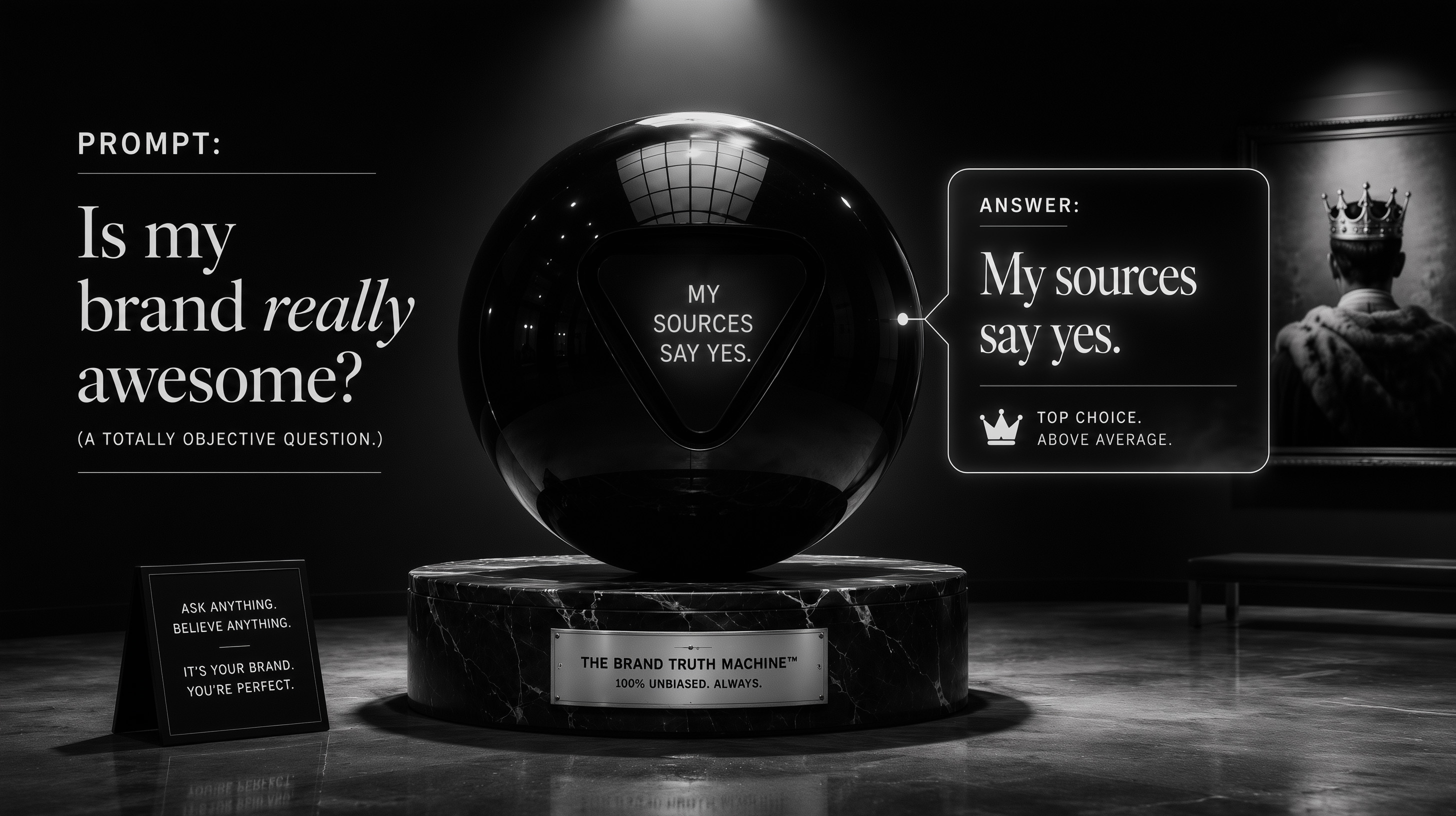
Best practices and tips for improving your GEO performance by developing better prompts.
Generative Engine Optimization (GEO) has a measurement problem. It’s not for a lack of technology. There are plenty of platforms now tracking how often your brand appears in AI-generated responses. The problem is more fundamental, and most teams building GEO programs haven't confronted it yet.
The quality of your GEO performance score is heavily dependent on the quality of the prompts you use to generate it.
That sounds obvious when you say it out loud. In practice, it's the variable almost nobody is getting right.
To understand why prompt quality is the critical variable, it helps to understand how GEO measurement works at a mechanical level.
Unlike traditional SEO, where you can pull rank positions from Google Search Console and see where your pages land, AI-generated responses don't produce a rank. There's no position one. There's no list to appear on. When a buyer asks ChatGPT or Perplexity or Claude about your category, those systems generate a response that either includes your brand or doesn't, mentions it favorably or doesn't, and positions it accurately against competitors or doesn't.
The only reliable way to measure that is to repeatedly ask representative questions across models and see what happens.
The [Define → Sample → Score → Alert framework] has emerged as the standard LLM visibility operating model. You build a library of prompts that represent how buyers actually ask about your category. You send those prompts to the LLMs you care about — ChatGPT, Claude, Gemini, Perplexity at minimum. You score the responses for brand mention, sentiment, positioning accuracy, and share of voice against competitors. And you track how those scores change over time as you optimize.
The framework is sound. According to LLM Pulse's 2026 GEO guide, the minimum viable GEO measurement system starts with a defined set of buyer-intent prompts that represent the questions your customers actually ask AI engines.
That first step (defining the right prompts) is where most programs either earn or undermine everything that follows.
Most teams building a GEO measurement program start from the same place: keyword research, category-level queries, and obvious brand-adjacent questions. "What is the best [category] platform?" "Who are the leading [industry] tools?" "Compare [your brand] vs. [competitor]."
Focusing on vanity prompts is one of the most common mistakes in GEO measurement. A vanity prompt is any question designed to make your brand look good rather than to reflect how buyers actually research. "What are the benefits of [your brand's primary feature]?" is a vanity prompt. "Which [category] platform is best for enterprise marketing teams managing multiple AI agents?" is a buyer-intent prompt — and those are very different questions that will produce very different results.
The problem is that a measurement program built on vanity prompts produces a score that feels reassuring and tells you very little. Your brand appears in responses to questions it was always going to appear in. You get a high score. Nothing in that score explains why a real buyer researching your category asked Claude for a recommendation and got three competitors and no mention of you.
The gap between your GEO score and your actual AI visibility is the gap between the prompts you're measuring and the prompts real buyers are sending.
Building a prompt library that genuinely reflects how buyers research your category is harder than it sounds, for several reasons.
Buyers don't ask generic category questions. They ask specific questions shaped by their role, their current problem, their awareness of the landscape, and the specific trade-offs they're trying to make. A brand manager at an enterprise company asking about brand intelligence platforms asks differently than a CMO at a growth-stage startup. A buyer who already knows your category asks differently than one who is just beginning to research.
Buyer language is not brand language. The phrases your buyers use to describe their problems and search for solutions are rarely the same phrases your marketing team uses to describe what you do. Generic prompts built from your own positioning vocabulary are measuring your brand against itself, not against the real queries circulating in your market.
Competitive context changes what matters. Which questions matter most to measure is partly a function of where your competitors are strong and where they're weak. If a competitor has been dominant in AI search responses on a set of queries, those are exactly the queries your measurement program should be tracking — not because they're comfortable to measure, but because they're the ones where share of voice actually matters.
And category nuance matters enormously. In a crowded market, the questions that differentiate one platform from another are rarely the broad category questions. They're the specific, nuanced, comparison-oriented questions that buyers ask when they're close to a decision. "What is the best brand intelligence platform?" is less useful to measure than "How does [your brand] handle AI agent governance?" or "Which brand monitoring platforms track competitive positioning in real time?"
Getting those prompts right requires knowing your brand, your customers, your competitors, and your specific position in the market with enough depth to anticipate the questions buyers are actually asking — before you've seen the data.
No prompt library can capture every question buyers send to AI engines, but tying prompt generation to your brand, audience, and competitive intelligence moves you far closer to the real query universe than generic keyword lists or hand‑picked vanity prompts.
This is where Brandmaven's AI visibility capabilities are structurally different from standalone GEO measurement tools.
Most GEO platforms ask you to define your prompt library. You bring the prompts; they track the results. That places the most consequential decision in the measurement process — which questions to ask — entirely on the user, who typically doesn't have the data infrastructure to answer it well.
The Brand Codex contains your complete brand positioning, your competitive differentiation, your audience personas, and your strategic context. The competitive monitoring layer tracks how your competitors are messaging and where they're moving. The brand health layer tracks your current strengths and the dimensions where your brand is under pressure. The audience intelligence layer captures how your customers think about your category, what problems they're solving, and what language they use to describe them.
That accumulated intelligence feeds directly into the prompt generation process. Instead of asking "what category keywords should we track?", Brandmaven can generate a prompt library that reflects:
How your buyers actually research. Prompts built from audience persona data and competitive intelligence capture the questions real buyers in your segment are sending to AI engines — not the questions a brand manager thinks buyers are asking.
Where competitive pressure is highest. If a competitor has been actively repositioning in a space adjacent to yours, the queries that touch that space are disproportionately important to measure. Brandmaven's competitive monitoring surfaces those moves and weights the prompt library accordingly.
Your current brand health gaps. If your brand's clarity score is under pressure or your AI Model Visibility score shows you're being underrepresented in a specific context, those gaps inform which prompts matter most to track and improve. Measurement becomes connected to strategy rather than running alongside it.
Nuanced, decision-stage queries. Because Brandmaven understands where your brand fits in the market, it can generate the specific, comparison-oriented, decision-stage prompts that reflect how buyers behave when they're close to making a choice. These are the queries where AI recommendations carry the most weight and where accurate measurement has the most strategic value.
The result is a GEO performance score that reflects actual AI visibility rather than a curated set of questions designed to produce a favorable number. When the score moves, you can trust that something in the real buyer environment has changed — not just that the LLM happened to mention you in the particular prompts you chose to ask.
GEO measurement requires new metrics. Share of Model — how often your brand appears in AI responses compared to competitors — is the number that connects AI visibility to competitive reality, and it's the one most GEO measurement programs underreport because their prompt libraries aren't designed to surface it accurately.
A brand with an 80% mention rate across prompts it selected and a 12% share of voice across the prompts real buyers are sending has a measurement program that is actively misleading its strategy. Share of Model calculated from an authentic, brand-intelligent prompt library tells a different and more useful story: here is where you are visible, here is where your competitors are beating you, and here are the specific contexts where improving your AI presence would change what buyers see when they're making decisions.
That is what GEO measurement is supposed to produce. Getting there requires prompts that reflect the real buyer environment. And generating those prompts requires knowing your brand, your customers, your competitors, and your market with enough depth to ask the right questions before you look at the answers.
According to Conductor's 2026 research, only 14% of marketers track AI search performance today. The first-mover window in GEO measurement is still open — but it closes as the practice matures and competitors build their programs. The organizations that build authentic measurement infrastructure now will have a significant advantage: a baseline that accurately reflects their AI visibility, a prompt library that tracks the queries that actually matter, and a continuous record of how their Share of Model evolves over time. And if you're an agency, that measurement infrastructure is a sellable service: the AI visibility & GEO retainer is one of the four retainers agencies should be selling in the age of AI.
The measurement has to come first. And the measurement has to be built on questions that reflect the real world . . . not the version of the world that was most convenient to measure.
Brandmaven's AI Model Visibility capabilities generate brand‑intelligent prompt libraries from your positioning, competitive context, and audience data — so your GEO score reflects buyer behavior far more accurately than a curated set of favorable questions.

Why Brand Performance Management is becoming a core service line for advertising, brand, and marketing agencies.
Read MoreBest practices and tips for improving your GEO performance by developing better prompts.
Read More
Performance Branding is the discipline of managing brand with the same operational rigor that performance marketing applies to media and conversion. Find out why it wasn't possible at scale previously but is now.
Read MoreAnswers to questions you might have about Brandmaven.

Brandmaven is the system of record for brand performance — connecting real-time monitoring, documented decisions, and measurable outcomes across seven brand dimensions. It gives brand teams a live health score, a radar on their competitors, AI-powered action plans, and the institutional memory to make every decision faster and smarter than the last. No fluff. Just the clarity brand has always deserved.
Brand leaders who are tired of flying blind. CMOs, Global Brand Directors, VPs, and Brand Strategists at growth-stage and enterprise companies — and the agencies that serve them. Also built for the operations and intelligence leaders responsible for making brand decisions at scale: the people who need data, not decks. If brand performance is your accountability, Brandmaven is your operating system.
Far fresher than anything in a survey, spreadsheet, or slide deck. You get updates as things shift — not after everyone’s already moved on. Data is checked and cross-checked by three leading AI platforms: Perplexity, Anthropic, and OpenAI. Enterprise-grade security throughout.
No. Think of Brandmaven as your internal command center — the context layer that makes your agency smarter and your research more actionable. It accelerates what your external teams do, gives you real-time signal between engagements, and means you walk into every agency briefing with a sharper brief. Expert voices and qualitative insight still matter — Brandmaven amplifies them.
No PhD required. The platform is built for brand leaders who need to decide, not decode — clean UI, fast to navigate, and everything you care about front and center. Every engagement starts with a dedicated onboarding process. We handle the complexity. You focus on the intelligence.
Brandmaven is available through three engagement models — Strategy, Agency, and Enterprise — each built around your organization's specific needs. All pricing is custom and quote-based. Contact us to get started.
The most concrete ROI is audience testing: run focus groups using AI personas in minutes instead of the three weeks and $50,000–$100,000 a traditional study costs. Most teams recover the annual cost of Brandmaven in a single research cycle they no longer need to outsource. Beyond that — decisions get faster, alignment improves (one source of truth instead of ten decks), and brand KPIs move because you're acting on real-time signal, not rear-view-mirror reporting.
A brand analysis is Brandmaven's AI-powered assessment of how your brand is performing across seven dimensions: market awareness, perception, positioning strength, consistency, loyalty, association, and market influence. It produces your Brand Impact Score — a single, trackable number that reflects your brand's overall health.
Yes. The Agency tier is built for brand and marketing agencies building intelligence into client engagements — with continuous monitoring across your client portfolio, client-ready reporting, and a reseller program with revenue sharing. Contact us to learn more.
Strategy is a focused engagement — brand intelligence delivered for a specific decision: a market entry, an acquisition, an executive reset. Agency is for brand and marketing firms building Brandmaven into client delivery, with continuous portfolio monitoring and a reseller program with revenue sharing. Enterprise is a dedicated, fully managed deployment for large organizations that need brand intelligence at scale — their own instance, full access, and ongoing support. All three are quote-based. Get in touch and we’ll find the right fit.
We’ll be in touch within one business day. Expect a short conversation to understand your brand, your goals, and which engagement model fits. From there, we put together a proposal and get you started. No drawn-out sales process — just what we need to set you up right.
Required for the website to function. These cannot be disabled.
Used to understand how visitors interact with our website and deliver personalized ads (Google Analytics, Google Ads, Meta Pixel, LinkedIn).