


Learn how Brandmaven serves up brand intelligence and governance insight to creative and GTM teams on a platter — in the tools they already use.
Some brand intelligence software requires you to log in, search, and find what you need every time you need it. You remember it exists, you open a new tab, you navigate to the dashboard, you locate the thing you were looking for, and by that point the moment has passed and you've already made the decision without it.
Brandmaven was built around a different premise: brand intelligence should show up where you already are, in the tools you already use, at the moment it's actually relevant. Three features make that real and none of them require you to open the Brandmaven platform to get value from them.
Most organizations track competitors the same way they've always tracked them: someone on the team periodically visits competitor websites, screenshots what they see, drops it into a Slack channel, and calls it competitive intelligence. The result is a picture that's accurate as of whenever someone last had time to look, which is rarely when you need it most.
Brandmaven's competitive tracker bascially cyberstalks your competitors' websites continuously and sends a direct alert the moment a significant change is detected. A competitor updates their homepage headline. They change their pricing page. They launch a new product page. They quietly shift the language in their value proposition. You know about it the same day it happens, not the same quarter.
The alert arrives in your inbox or your Slack workspace (no login required, no dashboard to check). The notification includes what changed, where it changed, and enough context to make an immediate judgment about whether it matters. Sometimes it doesn't. Sometimes it's the kind of move that reshapes the competitive landscape and changes what your brand needs to say next.
The difference between finding out today and finding out next month is often the difference between a proactive response and a reactive one. Reactive brand strategy is expensive. Proactive brand strategy is a competitive advantage. The alert is what makes the difference.
Most brand governance friction happens at the handoff point. The creative is in one place, the brand guidelines are in another, the person reviewing it is in a third place trying to hold all of it in their head at once. Something gets missed. Decisions get made on instinct. Content ships that a more deliberate process would have caught.
The Brandmaven Chrome Extension removes the handoff entirely.
When a team member is reviewing a piece of content, a creative concept, or a campaign asset in whatever tool they're already working in (Google Docs, a content management system, a design preview, an email platform) they can open the extension and assess it against Brandmaven's brand intelligence without leaving the page. Voice and tone check. Brand consistency assessment. Alignment with current positioning. Competitive context. All of it surfaced in the sidebar, right next to the work being reviewed.
For individual contributors, this means brand guidance is available at the exact moment a writing or design decision is being made, not after the fact. For managers and reviewers, it means feedback is grounded in the same brand intelligence the whole organization is working from, rather than personal judgment that may vary from person to person or day to day.
The extension also works for competitive research. Visit a competitor's website and the extension can surface how their positioning and messaging compares to yours. It's useful context when you're trying to identify where your brand has room to differentiate and where the territory is already crowded.
Another cool feature is the ability to test content, creative, and messaging with synthetic personas. Ask a lifelike, AI persona that represents your target audience how they feel about your homepage. Pre-test a campaign.
Brand governance has historically been a review-and-revise process that slows things down. The Chrome Extension makes it a point-of-creation resource that speeds things up, because it's faster to get it right the first time than to revise it after the fact.
This one is less visible than the other two, which is exactly the point.
Every time a team member opens an AI tool (Claude, ChatGPT, Copilot, Cursor, or any of the growing list of AI-powered marketing platforms) and asks it to produce something on behalf of your brand, that tool needs brand context to do it well. Without it, the output is generic. With a static brand brief pasted into the prompt, the output is only as current as the brief.
Brandmaven's Brand Codex connects to AI tools through a Model Context Protocol (MCP) server integration, which means those tools can pull your brand's current intelligence directly from the Codex before every generation. Automatically, without the team member doing anything differently and without anyone logging into Brandmaven to update a document first.
The AI tool gets your current brand voice parameters, your active positioning, your competitive context, and your audience personas. Not from a document someone last updated six months ago. From the same always-current brand intelligence layer that the rest of Brandmaven runs on.
The practical effect: a team member opens their AI writing tool, asks it to draft a campaign brief or a social post or a product description, and the output reflects your brand with a level of accuracy and specificity that standard prompting can't achieve. The Codex is doing the work in the background. The team member just gets better results.
This matters more as AI tool usage scales. One team member pasting a brand brief into a prompt is manageable. Fifty team members, ten agency partners, and a set of automated marketing agents each generating brand-adjacent content with no structured brand context is a governance problem. The MCP integration solves it at the architectural level so that as AI usage grows across the organization, brand coherence scales with it rather than breaking down.
These three features share a design philosophy: brand intelligence is most useful when it's embedded in the workflow, not waiting in a platform for someone to remember to check it. The competitive alert finds you when a competitor moves. The Chrome Extension is there when you're making a creative decision. The MCP integration ensures your AI tools are already briefed before anyone starts typing.
Together, they mean that brand governance happens continuously, in context, without the friction that has historically made brand governance feel like an obstacle to getting work done.
The platform is there when you need to go deeper. These features make sure the intelligence gets to you first.
See how Brandmaven works across your existing workflow. Explore the platform or start free.
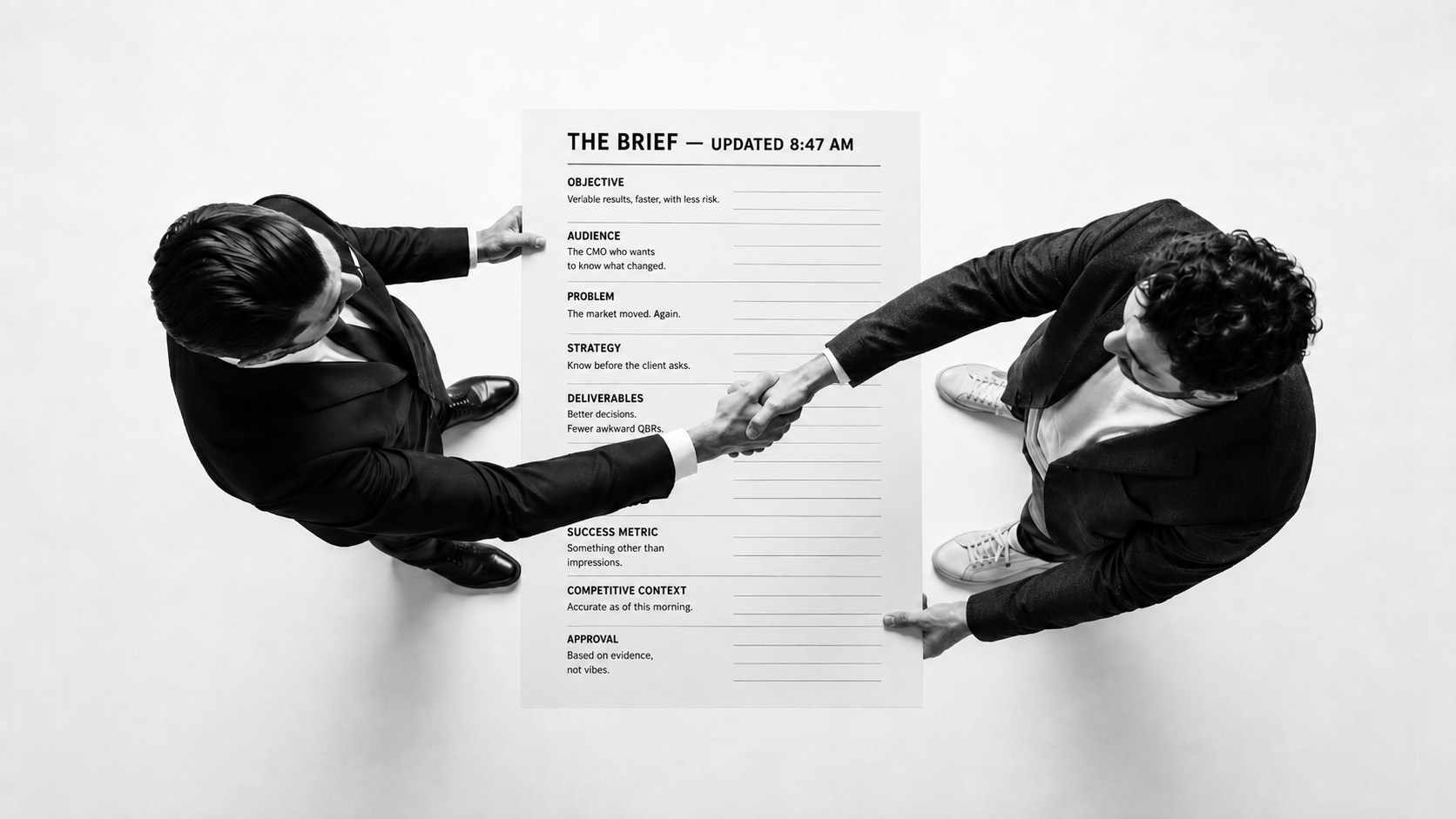
Why Brand Performance Management is becoming a core service line for advertising, brand, and marketing agencies.
Read More
Best practices and tips for improving your GEO performance by developing better prompts.
Read More
Performance Branding is the discipline of managing brand with the same operational rigor that performance marketing applies to media and conversion. Find out why it wasn't possible at scale previously but is now.
Read MoreAnswers to questions you might have about Brandmaven.

Brandmaven is the system of record for brand performance — connecting real-time monitoring, documented decisions, and measurable outcomes across seven brand dimensions. It gives brand teams a live health score, a radar on their competitors, AI-powered action plans, and the institutional memory to make every decision faster and smarter than the last. No fluff. Just the clarity brand has always deserved.
Brand leaders who are tired of flying blind. CMOs, Global Brand Directors, VPs, and Brand Strategists at growth-stage and enterprise companies — and the agencies that serve them. Also built for the operations and intelligence leaders responsible for making brand decisions at scale: the people who need data, not decks. If brand performance is your accountability, Brandmaven is your operating system.
Far fresher than anything in a survey, spreadsheet, or slide deck. You get updates as things shift — not after everyone’s already moved on. Data is checked and cross-checked by three leading AI platforms: Perplexity, Anthropic, and OpenAI. Enterprise-grade security throughout.
No. Think of Brandmaven as your internal command center — the context layer that makes your agency smarter and your research more actionable. It accelerates what your external teams do, gives you real-time signal between engagements, and means you walk into every agency briefing with a sharper brief. Expert voices and qualitative insight still matter — Brandmaven amplifies them.
No PhD required. The platform is built for brand leaders who need to decide, not decode — clean UI, fast to navigate, and everything you care about front and center. Every engagement starts with a dedicated onboarding process. We handle the complexity. You focus on the intelligence.
Brandmaven is available through three engagement models — Strategy, Agency, and Enterprise — each built around your organization's specific needs. All pricing is custom and quote-based. Contact us to get started.
The most concrete ROI is audience testing: run focus groups using AI personas in minutes instead of the three weeks and $50,000–$100,000 a traditional study costs. Most teams recover the annual cost of Brandmaven in a single research cycle they no longer need to outsource. Beyond that — decisions get faster, alignment improves (one source of truth instead of ten decks), and brand KPIs move because you're acting on real-time signal, not rear-view-mirror reporting.
A brand analysis is Brandmaven's AI-powered assessment of how your brand is performing across seven dimensions: market awareness, perception, positioning strength, consistency, loyalty, association, and market influence. It produces your Brand Impact Score — a single, trackable number that reflects your brand's overall health.
Yes. The Agency tier is built for brand and marketing agencies building intelligence into client engagements — with continuous monitoring across your client portfolio, client-ready reporting, and a reseller program with revenue sharing. Contact us to learn more.
Strategy is a focused engagement — brand intelligence delivered for a specific decision: a market entry, an acquisition, an executive reset. Agency is for brand and marketing firms building Brandmaven into client delivery, with continuous portfolio monitoring and a reseller program with revenue sharing. Enterprise is a dedicated, fully managed deployment for large organizations that need brand intelligence at scale — their own instance, full access, and ongoing support. All three are quote-based. Get in touch and we’ll find the right fit.
We’ll be in touch within one business day. Expect a short conversation to understand your brand, your goals, and which engagement model fits. From there, we put together a proposal and get you started. No drawn-out sales process — just what we need to set you up right.
Required for the website to function. These cannot be disabled.
Used to understand how visitors interact with our website and deliver personalized ads (Google Analytics, Google Ads, Meta Pixel, LinkedIn).