


Brand is the only major organizational asset managed without a real-time measurement system. Awareness surveys and NPS aren't brand measurement — they're brand archaeology. Here's what continuous measurement actually looks like.
Peter Drucker never actually said "if you can't measure it, you can't manage it." But whoever did say it was right and nowhere is that truth more consequential, or more consistently ignored, than in brand management.
Every serious organizational function has a measurement system. Finance has real-time P&L. Sales has pipeline and conversion metrics. Marketing has attribution dashboards. HR has headcount, retention rates, time-to-hire. Operations has throughput, defect rates, cycle times. Even culture, perhaps the most intangible of organizational assets, gets measured through engagement surveys and eNPS scores.
Brand? Brand gets measured when someone commissions a study. Which happens every twelve to eighteen months if you're lucky, covers only the dimensions the research firm knows how to ask about, arrives as a PDF three months after the data was collected, and is outdated before the strategy team finishes reading it.
This is more like archaeological excavation than it is measurement.
Let's be honest about the current state of the brand performance measurement, because it's important to understand what's actually being measured before we can understand what's missing.
The standard toolkit for brand measurement includes: aided and unaided awareness surveys, Net Promoter Score, brand tracking studies conducted by research firms, social listening dashboards that capture mentions and sentiment, share of voice calculations based on media monitoring, and the occasional brand equity study tied to financial valuation.
These tools are not worthless. Awareness data is useful. NPS reveals something real about customer sentiment. Share of voice tells you something about competitive visibility.
But collectively, they have three fatal limitations that make them insufficient as a management system.
They are lagging, not leading. By the time a brand tracking study arrives, the conditions it measured have already changed. You're reading a report about where your brand was six months ago, making decisions about where you want it to be in twelve months, with no real-time signal in between.
They are external, not internal. Every standard brand measurement tool measures perception from the outside (what customers, prospects, and the market think of the brand). None of them measure what's happening inside the organization: whether the brand is being applied coherently, whether brand decisions are being made consistently, whether the gap between intended and actual brand is widening or narrowing.
They are episodic, not continuous. Brand health is tracked in intervals (quarterly, semi-annually, annually). In between those intervals, the brand operates in the dark. Decisions are made, campaigns run, products launch, leaders change, all without any real-time signal about brand impact.
You wouldn't run your business with financial data that arrives twice a year. Why are you running your brand that way?
The other problem with current brand measurement is that it doesn't measure the right things. Awareness is necessary but not sufficient. A brand can be highly aware and deeply incoherent. A brand can have strong NPS among existing customers while actively failing to build the associations it needs to grow.
A complete brand measurement system needs to track across multiple dimensions simultaneously. Not just awareness, but positioning strength (do people understand what you stand for and why it's different?), consistency (is the brand applied coherently across channels and functions?), perception (how does the market actually feel about the brand?), association (what ideas, qualities, and values do people connect to the brand?), loyalty (are customers staying, returning, and referring?), and market influence (is the brand shaping the conversation in its category?).
These dimensions interact. A gain in awareness without a corresponding gain in positioning strength often means you're getting louder without getting clearer. Strong loyalty without strong association often means customers like you for reasons that won't scale. High influence without strong consistency means your category presence is built on a fragile foundation.
Understanding brand health requires tracking all of these dimensions continuously, understanding how they move relative to each other, and being able to connect those movements to specific decisions and market conditions. Current tools don't do this. They measure slices of the picture, episodically, with significant lag.
The technology to close this gap now exists. AI systems can continuously monitor and synthesize signals across earned media, search behavior, competitive positioning, social sentiment, and customer language to produce a real-time, multi-dimensional picture of brand health — updated not twice a year, but continuously.
This is what automated brand tracking actually means: not just faster versions of the same surveys, but a fundamentally different architecture. Architecture that treats brand health as a living signal rather than a periodic snapshot.
The implications are significant. With continuous tracking, brand leaders can see the impact of decisions in near-real-time. They can detect perception drift before it becomes reputation damage. They can identify competitive moves that are affecting brand positioning and respond quickly. They can build institutional memory around what decisions moved what dimensions, creating a compounding intelligence advantage over time.
None of this is speculative. The infrastructure exists. The gap is organizational. Most brand leaders haven't yet demanded the continuous measurement system their function deserves, because they've become accustomed to managing in the dark.
Brand leaders have accepted episodic measurement not because it's adequate, but because nothing better was available. That's no longer true.
The measurement gap isn't just a marketing problem. When brand can't be measured continuously and rigorously, it can't be governed at the organizational level. It remains a marketing department concern rather than a CEO-level priority.
But brand . . . the promise an organization makes and keeps to customers . . . is fundamentally a whole-organization phenomenon. It affects recruiting (who wants to work here), retention (why employees stay), partnerships (who wants to be associated with you), investor perception, and customer lifetime value. These are CEO-level outcomes. They deserve CEO-level measurement infrastructure.
The organizations that close the brand measurement gap first will gain something their competitors don't have: the ability to make brand decisions with the same speed and confidence that they make financial and operational decisions. That's a durable competitive advantage and it starts with demanding better measurement.
You can't manage what you can't measure.
Start measuring.
This is the third post in a series on Brand Performance Management. Next: why Google Analytics was never built to measure brand — and what the difference costs you.
Previous: The Invisible Brand Tax: What Brand Incoherence Costs Actually You
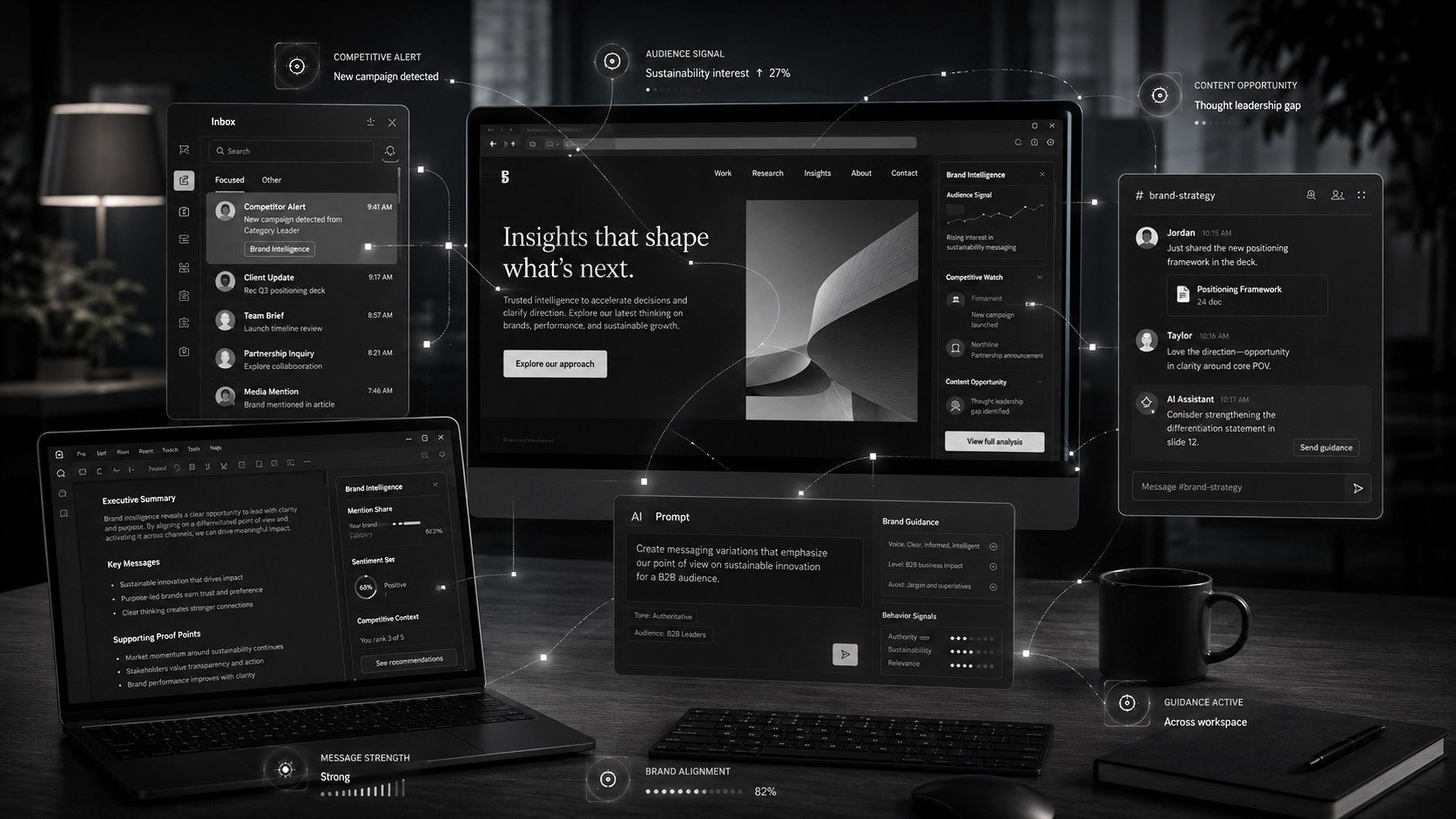
Learn how Brandmaven serves up brand intelligence and governance insight to creative and GTM teams on a platter — in the tools they already use.
Read More
AI is the most powerful execution engine marketing has ever had — which makes it dangerous when pointed at the wrong things. Here are five ways ungoverned AI execution damages your brand, and what to build to prevent it.
Read More
Learn why AI agents can't make "brand-safe" decisions based on static brand guidelines; they require an always-on, machine-readable decision layer that understands where your brand, competitors, and customers stand today.
Read MoreAnswers to questions you might have about Brandmaven.

Brandmaven is the system of record for brand performance — connecting real-time monitoring, documented decisions, and measurable outcomes across seven brand dimensions. It gives brand teams a live health score, a radar on their competitors, AI-powered action plans, and the institutional memory to make every decision faster and smarter than the last. No fluff. Just the clarity brand has always deserved.
Brand leaders who are tired of flying blind. CMOs, Global Brand Directors, VPs, and Brand Strategists at growth-stage and enterprise companies — and the agencies that serve them. Also built for the operations and intelligence leaders responsible for making brand decisions at scale: the people who need data, not decks. If brand performance is your accountability, Brandmaven is your operating system.
Far fresher than anything in a survey, spreadsheet, or slide deck. You get updates as things shift — not after everyone’s already moved on. Data is checked and cross-checked by three leading AI platforms: Perplexity, Anthropic, and OpenAI. Enterprise-grade security throughout.
No. Think of Brandmaven as your internal command center — the context layer that makes your agency smarter and your research more actionable. It accelerates what your external teams do, gives you real-time signal between engagements, and means you walk into every agency briefing with a sharper brief. Expert voices and qualitative insight still matter — Brandmaven amplifies them.
No PhD required. The platform is built for brand leaders who need to decide, not decode — clean UI, fast to navigate, and everything you care about front and center. Every engagement starts with a dedicated onboarding process. We handle the complexity. You focus on the intelligence.
Brandmaven is available through three engagement models — Strategy, Agency, and Enterprise — each built around your organization's specific needs. All pricing is custom and quote-based. Contact us to get started.
The most concrete ROI is audience testing: run focus groups using AI personas in minutes instead of the three weeks and $50,000–$100,000 a traditional study costs. Most teams recover the annual cost of Brandmaven in a single research cycle they no longer need to outsource. Beyond that — decisions get faster, alignment improves (one source of truth instead of ten decks), and brand KPIs move because you're acting on real-time signal, not rear-view-mirror reporting.
A brand analysis is Brandmaven's AI-powered assessment of how your brand is performing across seven dimensions: market awareness, perception, positioning strength, consistency, loyalty, association, and market influence. It produces your Brand Impact Score — a single, trackable number that reflects your brand's overall health.
Yes. The Agency tier is built for brand and marketing agencies building intelligence into client engagements — with continuous monitoring across your client portfolio, client-ready reporting, and a reseller program with revenue sharing. Contact us to learn more.
Strategy is a focused engagement — brand intelligence delivered for a specific decision: a market entry, an acquisition, an executive reset. Agency is for brand and marketing firms building Brandmaven into client delivery, with continuous portfolio monitoring and a reseller program with revenue sharing. Enterprise is a dedicated, fully managed deployment for large organizations that need brand intelligence at scale — their own instance, full access, and ongoing support. All three are quote-based. Get in touch and we’ll find the right fit.
We’ll be in touch within one business day. Expect a short conversation to understand your brand, your goals, and which engagement model fits. From there, we put together a proposal and get you started. No drawn-out sales process — just what we need to set you up right.
Required for the website to function. These cannot be disabled.
Used to understand how visitors interact with our website and deliver personalized ads (Google Analytics, Google Ads, Meta Pixel, LinkedIn).