


Brand Performance Management is the operating model that treats brand as a governed organizational asset — measured continuously, decided rigorously, and learned from systematically. Here's what it looks like in practice and why now is the moment to adopt it.
This is the final post in a series that began with a simple, uncomfortable observation: brand is the most valuable intangible asset most organizations own, and the least governed one. Seven posts later, the case is made. Now it's time to describe the solution (not as a product, but as a discipline). A new operating model that the best brand organizations will adopt in the coming decade, and that will separate the ones that win from the ones that wonder why they keep losing ground despite continuous investment.
That discipline is Brand Performance Management.
Brand Performance Management (BPM) is the organizational capability to monitor, measure, and improve brand health with the same rigor that finance applies to revenue, operations applies to efficiency, and people teams apply to organizational health. It is an operating model . . . a set of systems, processes, and disciplines that treat brand as a governed organizational asset rather than a creative output managed by instinct.
At its core, BPM rests on three principles that distinguish it from everything that has come before it in the brand management discipline.
Brand Performance Management is what happens when an organization finally decides to treat its most valuable intangible asset with the same seriousness it applies to every other asset it measures, manages, and reports on.
What does BPM actually look like inside an organization that has adopted it?
It looks like a brand health dashboard that brand leaders, CMOs, and CEOs check with the same regularity they check revenue dashboards. Not because they're required to, but because the information is genuinely useful for the decisions they're making. It shows current scores across brand dimensions, trend lines, competitive comparisons, and flags when something is moving in an unexpected direction.
It looks like a brand decision process that begins with documentation. Before a significant brand initiative launches, someone writes down the hypothesis: what dimensions are we trying to move, why do we believe this initiative will move them, what would success look like, and what timeframe are we working with? This takes minutes. It creates accountability without bureaucracy. And it means that six months later, when results are reviewed, the organization is comparing outcomes to intentions rather than reconstructing what the intention was from fading memory.
It looks like a competitive intelligence function that is continuous rather than episodic. Instead of commissioning competitive audits twice a year, BPM-driven organizations monitor how competitor brands are moving in real time, detecting positioning shifts, messaging changes, and market narrative movements as they happen rather than after the market has already responded to them.
It looks like an AI visibility function that monitors how the brand is represented by AI systems and ensures that the brand signals being synthesized by those systems are coherent with intended positioning. As AI-mediated discovery becomes the primary way customers evaluate brands in many categories, this moves from a nice-to-have to a core brand management responsibility.
And it looks like a system of record that is genuinely alive — updated when decisions are made, when outcomes are measured, when competitive conditions change, when the organization's understanding of its own brand evolves. Not a document. A living infrastructure.
The timing of this shift matters. BPM is becoming possible now for three reasons that weren't true five years ago.
First, AI has made continuous brand monitoring technically and economically feasible at a scale that wasn't previously achievable. The data synthesis required to track brand health across multiple dimensions in real time was simply too costly and complex for most organizations to build. That barrier is gone.
Second, the business environment has made brand incoherence more costly than it has ever been. Distributed workforces, AI-mediated discovery, audience intolerance for performative values, and compressed competitive cycles mean the consequences of brand drift are faster and more severe than they used to be.
Third, the discipline is genuinely new enough that early movers will establish positions that are difficult to replicate. The organizations that adopt BPM infrastructure now (building the measurement systems, the decision records, and the institutional memory) will have a compounding advantage over latecomers that grows every year.
The window for category leadership in Brand Performance Management is open. The organizations that move now will define what best-in-class looks like. The ones that wait will be playing catch-up against a moving target.
This series has made a claim: that brand management as currently practiced is structurally inadequate to the demands of the organizations that depend on it, and that Brand Performance Management represents a genuinely new and necessary operating model for the discipline.
The infrastructure to practice BPM at a high level exists. The organizations that adopt it will make better brand decisions, faster, with more confidence, and with a compounding learning advantage that grows every quarter.
The ones that don't will keep doing what they've always done: investing heavily in brand, measuring the outputs they can see, and remaining structurally blind to the health, coherence, and performance of the asset underneath.
Your brand is your most valuable intangible asset.
It deserves an operating model worthy of that status.
The discipline exists. The infrastructure is available. The only thing left is the decision to start.
This concludes the Brand Performance Management series. Share these posts freely with anyone who leads, manages, or cares about brand.
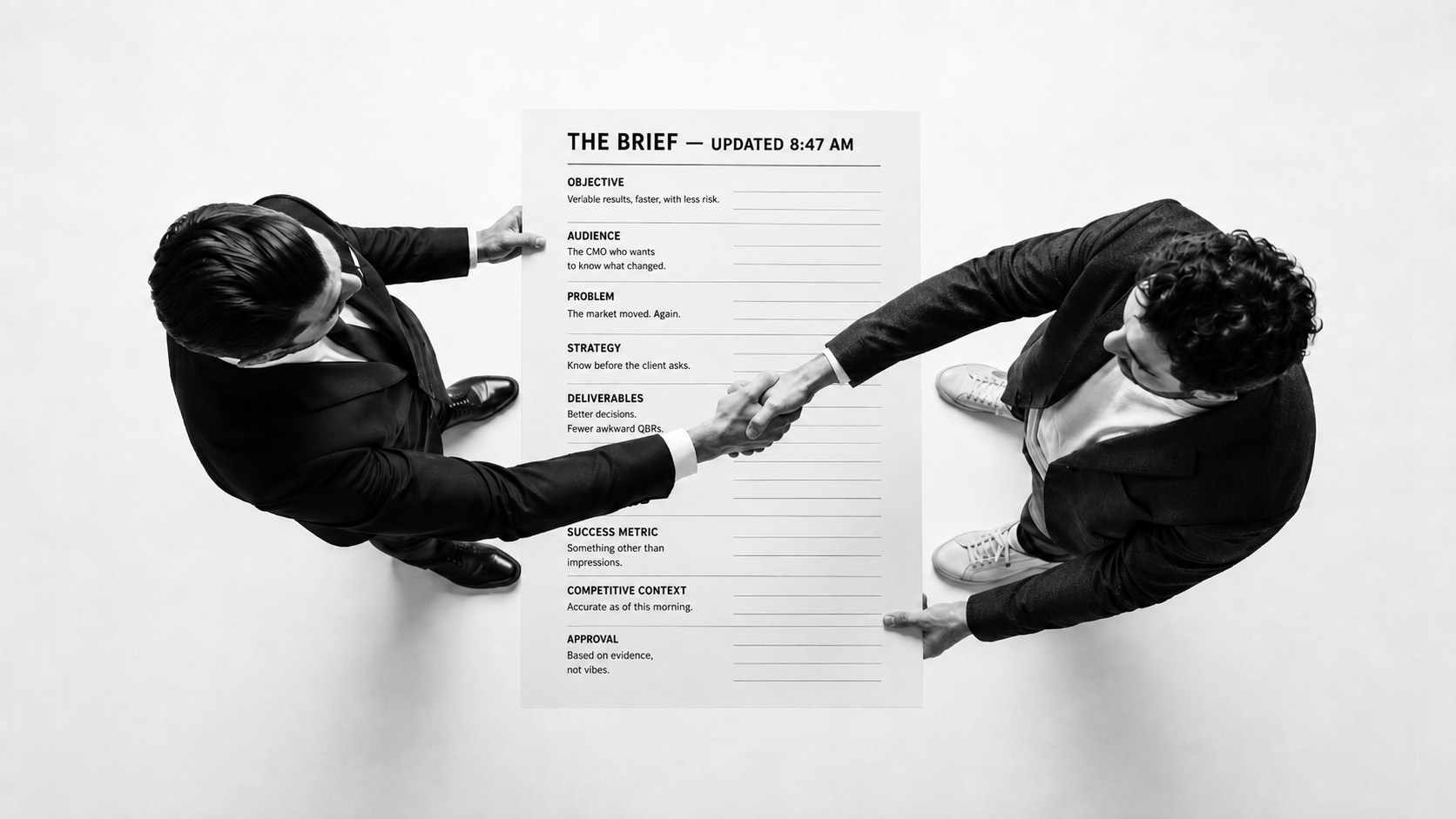
Why Brand Performance Management is becoming a core service line for advertising, brand, and marketing agencies.
Read More
Best practices and tips for improving your GEO performance by developing better prompts.
Read More
Performance Branding is the discipline of managing brand with the same operational rigor that performance marketing applies to media and conversion. Find out why it wasn't possible at scale previously but is now.
Read MoreAnswers to questions you might have about Brandmaven.

Brandmaven is the system of record for brand performance — connecting real-time monitoring, documented decisions, and measurable outcomes across seven brand dimensions. It gives brand teams a live health score, a radar on their competitors, AI-powered action plans, and the institutional memory to make every decision faster and smarter than the last. No fluff. Just the clarity brand has always deserved.
Brand leaders who are tired of flying blind. CMOs, Global Brand Directors, VPs, and Brand Strategists at growth-stage and enterprise companies — and the agencies that serve them. Also built for the operations and intelligence leaders responsible for making brand decisions at scale: the people who need data, not decks. If brand performance is your accountability, Brandmaven is your operating system.
Far fresher than anything in a survey, spreadsheet, or slide deck. You get updates as things shift — not after everyone’s already moved on. Data is checked and cross-checked by three leading AI platforms: Perplexity, Anthropic, and OpenAI. Enterprise-grade security throughout.
No. Think of Brandmaven as your internal command center — the context layer that makes your agency smarter and your research more actionable. It accelerates what your external teams do, gives you real-time signal between engagements, and means you walk into every agency briefing with a sharper brief. Expert voices and qualitative insight still matter — Brandmaven amplifies them.
No PhD required. The platform is built for brand leaders who need to decide, not decode — clean UI, fast to navigate, and everything you care about front and center. Every engagement starts with a dedicated onboarding process. We handle the complexity. You focus on the intelligence.
Brandmaven is available through three engagement models — Strategy, Agency, and Enterprise — each built around your organization's specific needs. All pricing is custom and quote-based. Contact us to get started.
The most concrete ROI is audience testing: run focus groups using AI personas in minutes instead of the three weeks and $50,000–$100,000 a traditional study costs. Most teams recover the annual cost of Brandmaven in a single research cycle they no longer need to outsource. Beyond that — decisions get faster, alignment improves (one source of truth instead of ten decks), and brand KPIs move because you're acting on real-time signal, not rear-view-mirror reporting.
A brand analysis is Brandmaven's AI-powered assessment of how your brand is performing across seven dimensions: market awareness, perception, positioning strength, consistency, loyalty, association, and market influence. It produces your Brand Impact Score — a single, trackable number that reflects your brand's overall health.
Yes. The Agency tier is built for brand and marketing agencies building intelligence into client engagements — with continuous monitoring across your client portfolio, client-ready reporting, and a reseller program with revenue sharing. Contact us to learn more.
Strategy is a focused engagement — brand intelligence delivered for a specific decision: a market entry, an acquisition, an executive reset. Agency is for brand and marketing firms building Brandmaven into client delivery, with continuous portfolio monitoring and a reseller program with revenue sharing. Enterprise is a dedicated, fully managed deployment for large organizations that need brand intelligence at scale — their own instance, full access, and ongoing support. All three are quote-based. Get in touch and we’ll find the right fit.
We’ll be in touch within one business day. Expect a short conversation to understand your brand, your goals, and which engagement model fits. From there, we put together a proposal and get you started. No drawn-out sales process — just what we need to set you up right.
Required for the website to function. These cannot be disabled.
Used to understand how visitors interact with our website and deliver personalized ads (Google Analytics, Google Ads, Meta Pixel, LinkedIn).