


The 2026 Q1 Brand Performance Index (BPI) provides a composite operating metric for brand performance. It uses AI-fueled intelligence gathering and analysis to show which brands are leading their industries.
In 2020, Peloton's brand seemed unstoppable. Retention rates hit 95%+. NPS scores exceeded 70 (among the highest in fitness). Revenue soared 172%. Every operational metric pointed to brand success.
Then the pandemic subsided, and Peloton's brand positioning collapsed overnight. Were they a fitness company? A technology company? A luxury lifestyle brand? Wall Street couldn't tell. Customers couldn't tell. Revenue fell 90% in two years despite maintaining strong product satisfaction among existing users.
Peloton's crisis reveals a fundamental problem with how brands measure performance: The right operational data was measuring the wrong strategic question.
For decades, brand leaders have been asked to answer one deceptively complex question:
The problem is not a lack of data. It’s that the wrong data has been used to answer the question.
Each tells part of the story. None tells the whole story.
That’s why we built the Brand Performance Index (BPI), a proprietary system designed to measure brand performance the way modern markets actually work. Visit the 2026 Q1 Brand Performance Index hub to review the index for 20+ industries.
Traditional brand measurement evolved in an era where marketing channels were limited and customer journeys were predictable. Today’s reality looks very different:
Yet most organizations still rely on lagging indicators.
Metrics like awareness, NPS, and pipeline contribution are useful but incomplete. They suffer from three critical limitations:
Brand leaders are left with data but no operating system for decision-making.
Brand has historically had fragments.
The Brand Performance Index (BPI) introduces something brand organizations have never truly had: A composite operating metric for brand performance.
Rather than tracking isolated signals, BPI synthesizes dozens of inputs — website traffic, social media presence, customer reviews, media coverage, analyst commentary, industry publications, competitive positioning data, and customer loyalty indicators into a unified system that comprises:
Think of it as a credit score for your brand, continuously updated, multi-dimensional, and tied to business outcomes.
The BPI evaluates brands across dozens of industries using seven core dimensions, producing both:

These scores allow organizations to benchmark themselves against competitors and understand where brand performance is accelerating or at risk.
The BPI evaluates brand strength across seven interconnected dimensions. Together, they provide a complete picture of how a brand exists, competes, and grows in the market.
Are you known by the right audiences?
Market Awareness measures how visible your brand is within its category and target market.
Signals include:
Business outcome:
Higher awareness expands consideration sets and increases the probability of inclusion early in buying journeys.
What do people believe about your brand?
Perception evaluates how audiences interpret and emotionally respond to your brand.
Signals include:
Business outcome:
Positive perception improves conversion efficiency, strengthens credibility, and supports premium positioning.
Do you clearly stand for something different?
Positioning Strength measures how effectively your brand communicates a distinct and defensible market position.
Signals include:
Business outcome:
Strong positioning reduces competitive friction and increases win rates by simplifying buyer decisions.
Does your brand show up the same way everywhere?
Consistency evaluates how reliably your brand is expressed across channels, teams, and customer touchpoints.
Signals include:
Business outcome:
Consistent brands build memory structures faster, accelerate recognition, and prevent brand dilution caused by fragmented execution.
Do customers stay, advocate, and return?
Loyalty measures the strength of ongoing relationships between your brand and its customers.
Signals include:
Business outcome:
High loyalty reduces acquisition costs, increases lifetime value, and creates durable growth independent of paid demand generation.
What ideas, values, and capabilities are linked to your brand?
Association evaluates the mental shortcuts audiences use when they think about your company.
Signals include:
Business outcome:
Strong associations ensure your brand is remembered for the *right reasons* — shaping consideration before buyers ever engage sales.
Does your brand shape the market — or react to it?
Market Influence measures a brand’s ability to lead conversations, define narratives, and move category direction.
Signals include:
Business outcome:
Influential brands command attention, set pricing expectations, attract partners, and disproportionately capture growth opportunities.
Each dimension feeds into a single Brand Impact Score, a composite measurement reflecting overall brand performance. This score answers the question executives actually care about:
Instead of debating disconnected metrics, leadership teams gain a shared operating view.
The companies winning today invest in brand and operate it with discipline. They recognize that:
Modern brand leadership requires a composite, forward-looking operating metric. That’s the role of the Brand Performance Index.
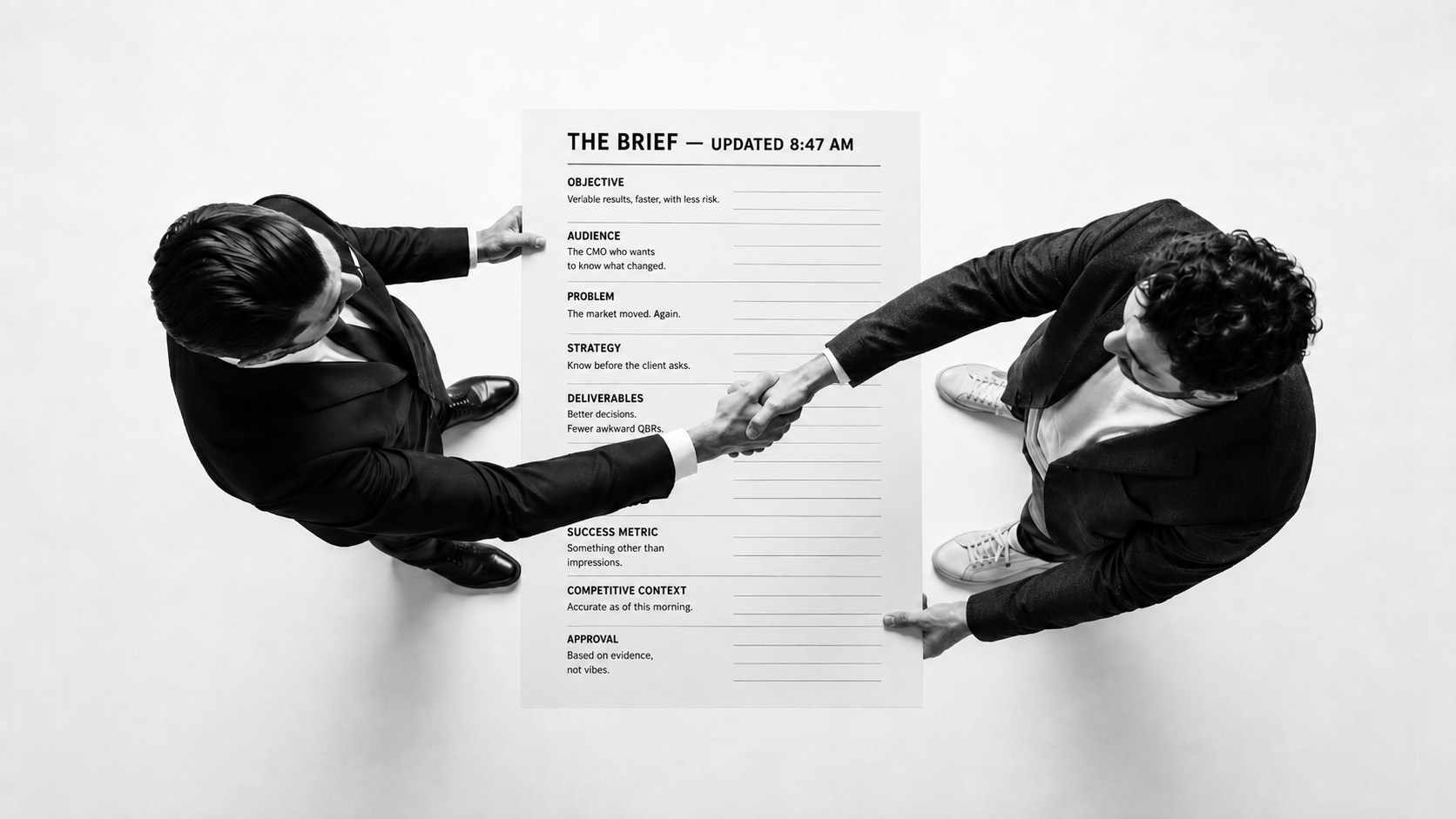
Why Brand Performance Management is becoming a core service line for advertising, brand, and marketing agencies.
Read More
Best practices and tips for improving your GEO performance by developing better prompts.
Read More
Performance Branding is the discipline of managing brand with the same operational rigor that performance marketing applies to media and conversion. Find out why it wasn't possible at scale previously but is now.
Read MoreAnswers to questions you might have about Brandmaven.

Brandmaven is the system of record for brand performance — connecting real-time monitoring, documented decisions, and measurable outcomes across seven brand dimensions. It gives brand teams a live health score, a radar on their competitors, AI-powered action plans, and the institutional memory to make every decision faster and smarter than the last. No fluff. Just the clarity brand has always deserved.
Brand leaders who are tired of flying blind. CMOs, Global Brand Directors, VPs, and Brand Strategists at growth-stage and enterprise companies — and the agencies that serve them. Also built for the operations and intelligence leaders responsible for making brand decisions at scale: the people who need data, not decks. If brand performance is your accountability, Brandmaven is your operating system.
Far fresher than anything in a survey, spreadsheet, or slide deck. You get updates as things shift — not after everyone’s already moved on. Data is checked and cross-checked by three leading AI platforms: Perplexity, Anthropic, and OpenAI. Enterprise-grade security throughout.
No. Think of Brandmaven as your internal command center — the context layer that makes your agency smarter and your research more actionable. It accelerates what your external teams do, gives you real-time signal between engagements, and means you walk into every agency briefing with a sharper brief. Expert voices and qualitative insight still matter — Brandmaven amplifies them.
No PhD required. The platform is built for brand leaders who need to decide, not decode — clean UI, fast to navigate, and everything you care about front and center. Every engagement starts with a dedicated onboarding process. We handle the complexity. You focus on the intelligence.
Brandmaven is available through three engagement models — Strategy, Agency, and Enterprise — each built around your organization's specific needs. All pricing is custom and quote-based. Contact us to get started.
The most concrete ROI is audience testing: run focus groups using AI personas in minutes instead of the three weeks and $50,000–$100,000 a traditional study costs. Most teams recover the annual cost of Brandmaven in a single research cycle they no longer need to outsource. Beyond that — decisions get faster, alignment improves (one source of truth instead of ten decks), and brand KPIs move because you're acting on real-time signal, not rear-view-mirror reporting.
A brand analysis is Brandmaven's AI-powered assessment of how your brand is performing across seven dimensions: market awareness, perception, positioning strength, consistency, loyalty, association, and market influence. It produces your Brand Impact Score — a single, trackable number that reflects your brand's overall health.
Yes. The Agency tier is built for brand and marketing agencies building intelligence into client engagements — with continuous monitoring across your client portfolio, client-ready reporting, and a reseller program with revenue sharing. Contact us to learn more.
Strategy is a focused engagement — brand intelligence delivered for a specific decision: a market entry, an acquisition, an executive reset. Agency is for brand and marketing firms building Brandmaven into client delivery, with continuous portfolio monitoring and a reseller program with revenue sharing. Enterprise is a dedicated, fully managed deployment for large organizations that need brand intelligence at scale — their own instance, full access, and ongoing support. All three are quote-based. Get in touch and we’ll find the right fit.
We’ll be in touch within one business day. Expect a short conversation to understand your brand, your goals, and which engagement model fits. From there, we put together a proposal and get you started. No drawn-out sales process — just what we need to set you up right.
Required for the website to function. These cannot be disabled.
Used to understand how visitors interact with our website and deliver personalized ads (Google Analytics, Google Ads, Meta Pixel, LinkedIn).